Every Kitchen Exhaust Cleaning company in the country performs the same basic sequence: arrive, inspect, clean, leave. The difference between a commodity and a defensible work product lives entirely in what gets measured and written down between those four steps.
Grease depth is the number that makes the record real.
What You Are Actually Selling
When a kitchen leader hires a KEC company, they are paying for a system that does not ignite. But what they receive — what they can point to, what survives a loss, what holds up when an authority having jurisdiction asks for documentation — is a job record. That record is only as strong as the data inside it.
Fuel load is the professional term for accumulated grease in a kitchen exhaust system. It is not a condition you can describe in general terms and have it mean anything. "Heavy buildup" is an opinion. A grease depth reading, logged before you touch the system, is a measurement.
The before reading and the after reading together tell the only story that matters: what was there, and what remains.
Why the Before Reading Is Non-Negotiable
Some crews skip the pre-clean measurement because the system is obviously dirty and the cleaning was already scheduled. That is a mistake.
Without a baseline, you have no way to quantify the fuel load you removed. You cannot show that the system was at a condition that warranted the service. You cannot demonstrate the delta — the change between the state you found and the state you left.
The after reading alone is a number floating in space. The before reading is what gives it meaning.
The Grease Depth Numbers That Matter
The standard that governs kitchen exhaust system maintenance references grease depth thresholds that determine whether a system is serviceable or requires action. The figures you measure and record are expressed in microns.
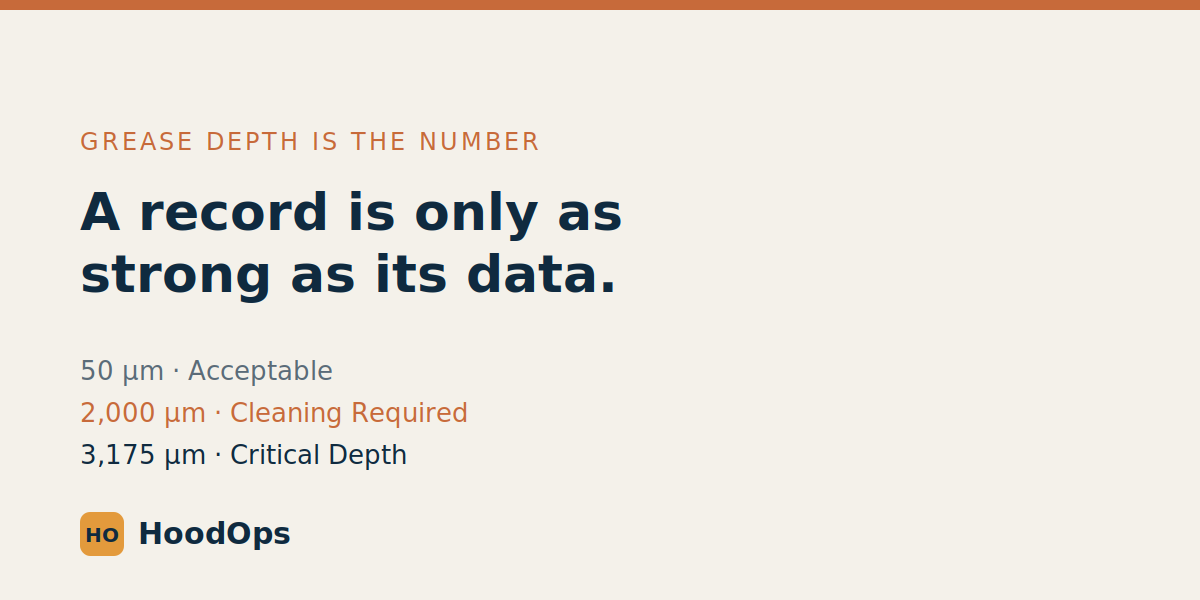
A reading at or above 2,000 microns is the Cleaning Required threshold — the system must be cleaned. A reading at or above 3,175 microns in a fan housing is the Critical Depth threshold — the system must be cleaned without delay. On the lower end, 50 microns is the Acceptable threshold — the mark of a properly cleaned system.
These are not internal benchmarks. They are the reference points drawn from the standard that an authority having jurisdiction may use when evaluating a system. When your job record carries these numbers — logged by location, logged before and after — your documentation speaks the same language as the standard itself.
How the Record Gets Built
A job record is not a single document. It is a chain of observations made at specific points in the service:
- Before the cleaning begins, log grease depth by location — filters, plenum, horizontal runs, vertical shafts, fan housing. Use consistent measurement points so the readings are comparable across service cycles.
- During the cleaning, note any conditions that were not visible on arrival: damaged components, obstructed access panels, areas that could not be fully reached, anything that affects the completeness of the service.
- After the cleaning, return to the same measurement points. Log the post-clean depths. Note any areas where depth could not be reduced to the 50-micron threshold and document why.
Every reading carries the technician's name, the date, and the location in the system. The record is not complete until all of that is in it.
What Makes a Record Defensible
A job record gets tested in two scenarios: a routine inspection by an authority having jurisdiction, and a loss event where documentation becomes evidence.
In the routine inspection scenario, an AHJ reviewing your paperwork wants to see that the service was systematic and that the system was left in a measurably cleaner condition than it was found. Grease depth readings give them that.
In a loss scenario, the question is whether the system was properly maintained. A record that shows grease depth by location, before and after, with technician attribution and timestamps, answers that question directly. A record that says "system cleaned, condition good" answers nothing.
The difference is not how well you cleaned. It is how well you documented what you measured.
The Standard Expects Measurement
Kitchen exhaust maintenance standards do not describe cleaning as a general activity. They describe it as a measured outcome. The standard sets inspection intervals based on cooking volume and fuel type — those intervals tell you how often the system must be inspected. Cleaning is triggered by what that inspection measures.
This is a distinction that matters when you are explaining your work to a kitchen leader or to an AHJ. You are not on a schedule because the calendar says so. You are on a schedule because the standard requires inspection at that interval, and cleaning is what the measurement found necessary.
Your job record should reflect that logic. Pre-clean depth justifies the service. Post-clean depth confirms it was completed.
Running the Work This Way
For KEC companies running multiple crews across multiple sites, the challenge is consistency. A job record built by one technician using one method on a Tuesday looks different from a record built by a different technician using a different method on a Friday. When those records go to the same client, or to the same AHJ, inconsistency is a problem.
The companies that have built durable businesses in this trade have done it by making measurement standard — not optional, not crew-dependent, not left to individual judgment on the day. Grease depth before and after is part of the job, the same way every time, on every site.
When that discipline is in place, the record builds itself. Every service produces documentation that is comparable to every other service. The client's file tells a coherent story across every visit. The AHJ sees a company that runs a system, not a company that cleans hoods and writes things down after.
The Work Product
A KEC company's work product is not a clean exhaust system. It is a clean exhaust system with a record that proves it.
The grease depth you log before and after is what makes that true. Without those numbers, you cleaned something. With them, you produced a record — and a record is what lasts.